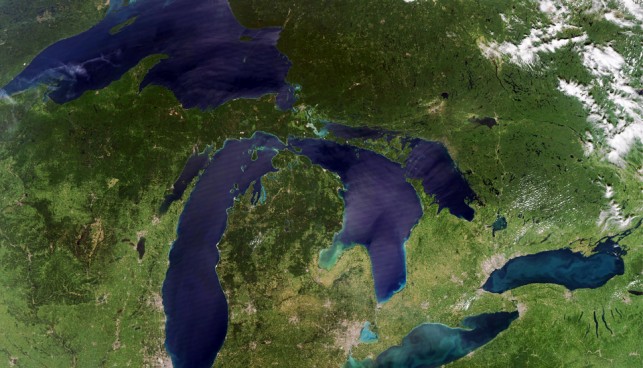



In June, Ontario’s Minister of the Environment stood at the shoreline of Lake Ontario in downtown Toronto to announce the introduction of Bill 100, the Great Lakes Protection Act, 2012. This broad new legislation would allow ministries to better cooperate on conservation initiatives – water quality, wastewater treatment, algae blooms, wetland restoration, etc. – while empowering community groups and nonprofits to take action on improving the lakes in their own backyards.
In June, Ontario’s Minister of the Environment stood at the shoreline of Lake Ontario in downtown Toronto to announce the introduction of Bill 100, the Great Lakes Protection Act, 2012. This broad new legislation would allow ministries to better cooperate on conservation initiatives – water quality, wastewater treatment, algae blooms, wetland restoration, etc. – while empowering community groups and nonprofits to take action on improving the lakes in their own backyards.
To administer funds and help set priorities for protecting the lakes at the local and basin levels, Environment Minister Jim Bradley outlined the creation of the Great Lakes Guardian Community Fund to “support community projects to help protect and restore the ecological health of the Great Lakes and St. Lawrence River Basin.”
The question motivating the four-year, $1.5-million fund is simple. Why would the government presume to know better than local conservation authorities, community groups, first nations or Métis about what restoration and protection projects would make the greatest impact?
Short answer: they don’t. So if your community could benefit from building a coastal or riverside trail, or if removing barriers in a stream that impede the creation of fish habitat or access to traditional spawning grounds, you can now apply to the MOE for money to make that local improvement.
So what’s the problem?
“We are perplexed,” said Claire Malcolmson, water program manager with Environmental Defence. Before Premier Dalton McGuinty prorogued the Ontario Legislature on Oct. 15, “the Great Lakes Protection Act was the only environmental legislation being advanced by the government. And it’s a good act, so we wish they would do more for it.”
Malcolmson is concerned the MOE provided too small a window of opportunity for public consultations, which occurred over 30 summer days in Toronto, Thunder Bay, Kingston, Windsor and Cambridge.
“The province did a lousy job communicating with the public regarding public consultation,” said Malcolmson. This is especially troubling given that the primary drive behind the legislation is to generate public interest in protecting the Great Lakes at a grassroots level.
How can the public become engaged when the government fails to adequately engage them?
Organizations like Environmental Defence have been advocating on behalf of the legislation, which died on the order paper at second reading stage when the House was prorogued. But for Malcolmson, “It’s not the responsibility of the charitable sector to promote this legislation.”
And she’s not alone in her concern.
“The Great Lakes are so hugely important to Ontario and its economy that it should be the kind of issue that rises to the top,” said Anastasia Lintner, staff lawyer with Ecojustice. “This can’t just seem like the MOE has another complicated new piece of legislation [because] it diminishes the importance of figuring these issues out in a way that’s lasting.”
Lintner agrees with Malcolmson that the “outreach has been disappointing,” and worries the success of the legislation is being jeopardized because the government is failing not only to educate the public, but also to build enthusiasm.
“The government had a number of initiatives to connect people to the Great Lakes, and yet the way the Ministry of the Environment has approached their outreach, it doesn’t match with the excitement that should exist,” said Lintner. “It will be a challenge to ensure its success now in government, without having generated excitement about a way to solve Great Lakes problems.”
A spokesperson for Minister Bradley counters this point by outlining the numerous ways in which the public has been able to get involved in the process. “Prior to drafting the proposed Great Lakes Protection Act, stakeholders including environmental groups, source protection committees, tourism and agriculture representatives, first nations and municipalities, were invited to meet with Minister Bradley to gain insight into their expectations and key issues for potential legislation,” said Lyndsay Miller.
“The proposed Act and draft Great Lakes Strategy were also posted on the Environmental Registry for public review and comment,” she said, including six “lake-by-lake stakeholder sessions” and well as three sessions with First Nations groups. Moreover, according to Miller the ministry held “additional meetings, teleconferences and events with interested sectors such as environmental groups, municipalities, Conservation Ontario, developers, recreational groups, agriculture, Environment Canada, First Nations and Métis, and other Great Lakes groups both domestically and bi-nationally.”
The 2012 application process closed October 12, but if you think your community group or nonprofit could benefit from Great Lakes guardian funding, the application guidelines for 2013 can be found here and the application form is here.
Read the follow-up post, Next Steps in Protecting the Great Lakes.
Andrew Reeves is the Editor-in-Chief of Alternatives Journal. Overrun, his book about Asian carp in North America, will be published in Spring 2019 by ECW Press. His work has also appeared in the Globe & Mail, Spacing and Corporate Knights. Follow him on Twitter.